Figure 1. The Cabinet of Dr. Caligari 1920 Poster Art
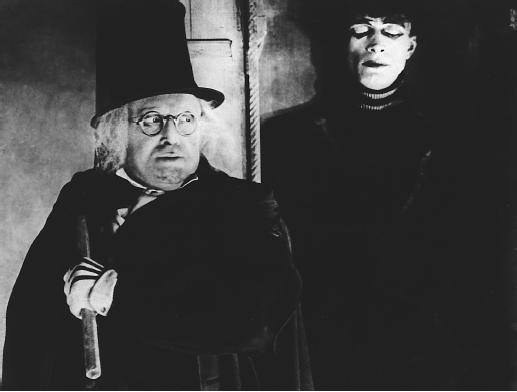
The Cabinet of Dr. Caligari is an operatic mystery into the human psyche of the clinically insane Dr. Caligari controlling the mentally submissive husk-like Cesare, the Somnambulist to inane acts of Sinicism. Lucrative set designs spiral flat front on but to ones disbelief expand to the realms of a black and white surrealist painting.
•Directed by: Robert Wiene
•Written by: Hans Janowitz, Carl Mayer
•Cast: Werner Krauss as Dr. Caligari, Conrad Veidt as Cesare, Lil Dagover as Jane, Friedrich Feher as Francis, Hans Heinrich von Twardow as Alan & Rudolf Lettinger as Dr. Olson.
•Genre: Horror, Art House & International, Mystery & Suspense, Classics, Cult Movies
•Duration: 71 Minutes (aprox)

Figure 2. "A somnambulist was committed to the asylum this morning... AT LAST!!!!!"
The Cabinet of Dr. Caligari was written to spite the use of Psychiatry due to the personal experiences of film writers Hans Janowitz & Carl Mayer. At the time the two wanted to break free from the generic conventions of film to explore an entirely new approach to the theme of murder. The film is told in the form of a story within a story which betrays its audience leaving them questioning the very premise & mentality of the real vs. the surreal.
“Was Carl Mayer and Hans Janowitz’ script based on an actual Hamburg carnival murder and/or is it a metaphor for Weimar Republic despair, “lawlessness and depravity”? Is it elitist or true earliest horror -- a New York première audience booed and demanded refunds.” (Levit: 2011)

Figure 3. "Step up! Step Up! See the amazing Cesare, the Somnambulist!"
When analysing the set design one could not help but notice the layers upon layers of unfolding landscapes, what one could initially assume as a flat would unfold revealing a depth as if walking into a painting on a wall. The sets are constructed entirely of organics with no truly solid surface or 4 sided planes, the camera effects & editing capitalises on this reliance creating a moving spotlight effect italicizing an active protagonist or dramatic shot. One could not help but feel that the shadows were overused, in saying that I believe that the film was shot with a number of faults due to its era vis-à-vis the birth and expansion of film.
“The Cabinet of Dr. Caligari” embodies an iconic brand of angular surrealism that defies gravity. The effect is unsettling.” (Smithey: 2011)

Figure 4. "Help! Help! It is he! The Killer!"
The Cabinet of Dr. Caligari is a film based more on suggestion which one could assume were many of the films of the 1920’s. One could not help but feel that to a modern audience a soundless approach is out-dated disconnecting its audience to vital story aspects and tones. In retrospect the story is engaging with a unique captivating twist shaking the boundaries of the real and the surreal, creating a world, filling it with answers before any questions are asked and then telling everyone it wasn’t real.
At this point we dissolve back to the young man, Francis, telling the visitor his story. Enter Dr Sonnow. Francis promptly attacks him, protesting he is Caligari. That is the delusion of Francis, and now that he knows his delusion, the innocent Dr Sonnow can cure him. The rest was a tale told by a madman. (Variety Staff: 1918)
List of Illustrations
Figure 1. The Cabinet of Dr. Caligari 1920 Poster Art. (com) [Online image]. At:
https://upload.wikimedia.org/wikipedia/commons/5/52/Das_Cabinet_des_Dr._Caligari.JPG>
(Accessed on:04/11/11)
Figure 2. A somnambulist was committed to the asylum this morning... AT LAST!!!!! (com) [Online image]. At:
http://www.filmreference.com/images/sjff_01_img0261.jpg (Accessed on:04/11/11)
Figure 3. Step up! Step Up! See the amazing Cesare, the Somnambulist! (com) [Online image]. At:
https://elmfilms11.files.wordpress.com/2011/01/cesare.jpg (Accessed on:04/11/11)
Figure 4. Help! Help! It is he! The Killer! (com) [Online image]. At:
https://blogger.googleusercontent.com/img/b/R29vZ2xl/AVvXsEgfxdWAmdYY9H15sVfUNaVVu89-TzO7i1KmNgYxfbGFwqWAXhfmI2ttoVtLKZ5T2BcxlGbMFYLGeE2FpmsPN01H_HPvLhHhbY9J5pmJr_cy-l4qdnDvAJOEFMRRf2_rXGuNbGQjAknTQVU/s400/cabinet-du-dr-caligari-02-g.jpg (Accessed on:04/11/11)
Bibliography
Levit, Donald. (2011) Inmates Run the Asylum At: http://www.reeltalkreviews.com/browse/viewitem.asp?type=review&id=3275
(Accessed on: 04/11/11)
Smithey, Cole. (2011) The Cabinet of Dr. Caligari - Classic Film Pick At: http://www.colesmithey.com/capsules/2011/10/the-cabinet-of-dr-caligari.html
(Accessed on: 04/11/11)
Variety Staff. (1918) The Cabinet of Dr Caligari Review At: http://www.variety.com/review/VE1117789633/ (Accessed on: 04/11/11)